Karen Craggs-Milne at the Brand Builder Competition
At the 2026 Brand Builder Competition, Speaker Slam®'s online competition for personal brand pitches, Karen Craggs-Milne delivered a brand pitch and was named 2026 Leader to Watch (2nd place).
Certified Diversity & Sustainability Expert, Founder of Conscious Equality Inc.
Mississauga, Ontario


Karen Craggs is a leading global expert in equity, diversity, anti-racism, gender equality, and inclusion, with over 25 years of international experience advancing meaningful systemic change. A proud Kenyan Canadian, she is widely recognized for helping organizations get equality work right with intention, strategy, and measurable impact. Karen has received numerous honours, including recognition by the Obama White House as a Gender Equality Changemaker, Global Goodwill Ambassador for the Sustainable Development Goals, LinkedIn Global Superhero, Top 100 Canadian Professional, and Top 25 HR Innovator. As Founder and CEO of Conscious Equality Inc., she has partnered with more than 150 NGOs, corporations, and governments worldwide.
“I'm thrilled to be back on stage at Speaker Slam!”
At the 2026 Brand Builder Competition, Speaker Slam®'s online competition for personal brand pitches, Karen Craggs-Milne delivered a brand pitch and was named 2026 Leader to Watch (2nd place).
Speaking on the theme Breakthrough at Speaker Slam® in Toronto on Mar 31, 2026, Karen Craggs-Milne delivered “Beyond Belonging”.
I'm 5 years old sitting on my grandmother's bed. She's braiding my hair and I'm asking her questions about what it means to belong to this family. Nani, what does Kiran mean? It means light. What does Tejal mean? It means radiance. What does Toral mean? It means strength. These are the names of my three cousins, cousins I've grown up with as sisters. We're often called the four musketeers because we are so alike. These girls have given me a sense of belonging. Nani, what does my name mean?
Karen, it means nothing. Your father is white. He chose to give you a white name. They don't think like us. They don't have customs and traditions like us. You are different. How many people here have ever experienced being different? Put your hands up. That hurt. And I chose not to accept it. So as I grew up, when people would ask me what my name meant, I would say, I was named after Karen Blixen, the woman who wrote Out of Africa. Made me feel important, sounded grand enough.
But here's the thing, when I learned about Karen Blixen, who has a museum in Nairobi, I decided that we weren't the same kind of person. She was different from me. My values were different and I didn't want to adopt who she was in my own path. So I stopped referring to that story. How many people here have adapted who they are to be more palatable to others? Later, and you'll recognize this, I woke up to a phone full of memes. What do you think those memes were about?
Karen. All of a sudden, I went from a name that had no meaning to a name that had meanings I didn't connect with to suddenly having a name that everybody hated. I thought it was funny at first. But, the fun turned into stereotypes. The stereotypes turned into insults. The insults turned into weaponry. Now, the word Karen wasn't just used to describe a mean, old, nasty woman. It was used to shut anybody down. I remember myself shrinking, silencing myself, avoiding situations where I would give anybody any reason to say, "There she is.
There's another Karen." It hurt to have my name turned into something so awful. And yet, I had to put a smile on cuz I didn't want to be that the Karen that couldn't take a joke. I published an article. It was amazing. Best work I'd ever done. And the next morning, I woke up and that article had gone viral. But, not because of the content I had created. It went viral because of the comment underneath that said, "Karen doing diversity work?
That's rich. I would have laughed except I was tired of being called Karen for the wrong reasons. That day I cried. I cried until I couldn't cry anymore. And then I sat up and I said, "Enough is enough. I am taking my name back." How do you do that in a world that decides that you have a target on your back? Have you ever felt like you have a target on your back just because you have the wrong name or the wrong religion or the wrong color of your skin?
It was not safe to be a Karen in that world. So, I said, "Who am I? If I'm not all these things that everybody wants me to be, who am I?" And the answer was clear. I'm kind. I'm compassionate. I'm caring. I'm the Karen that wears brilliant bright colors and flowers in her hair and just loves people. That's who I am. And I'm darned if a joke or an insult about my name is going to change that. So, I decided from that day onwards that I was going to show up fully as me.
Me. A category of one. If you have ever experienced not belonging, adjusting, having a target on your back, like you can't be this person that people have made you out to be, I want you to say to yourself today, say it with me now. I am a category of one. Say it with me. I am a category of one. Thank you.
Transcript generated from the recording and lightly cleaned. Some names and wording may differ from the spoken speech.
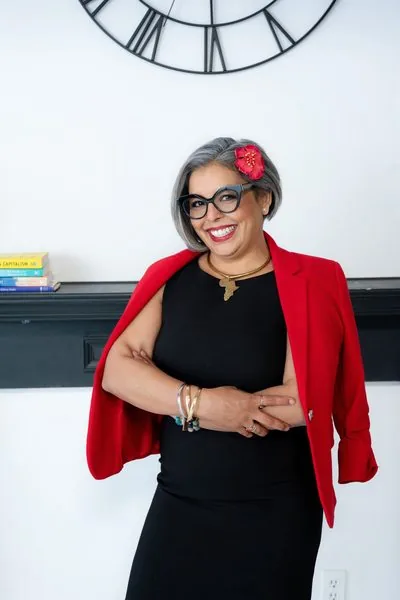
Speaking on the theme The Underdog at Speaker Slam® in Toronto on Jul 15, 2025, Karen Craggs-Milne took the stage with a five minute story.
Underdogs come in many shapes and sizes, but the one thing they all have in common is their ability to find hope in the darkest places and to keep that hope alive. I learned that powerful lesson when I was 16 volunteering in a public hospital in Kenya. I will never forget the day when I stood in front of a door that said Children's Cancer Ward. I opened it expecting hope and care. But what I found was the stench of disease and despair.
I found children with swollen limbs, disfigured faces, and tumors that tore out of their skin. Many were crying in agony while others lay there dead to all hope. I wanted to turn and run, but then I saw her, a girl about my age. She had a child in her hand. And I asked her, "Is this your sister?" "No," she said. "She was dropped off yesterday. She has brain cancer and she's going to die very soon." "She's all alone?" Yes. Look around you.
We're all alone. Our parents can't pay for any treatment. No money means no medicine and no medicine means no hope. We are all going to die. It's just our bad luck. I couldn't believe how she said that with such a matter of fact. Meanwhile, I could feel the rage. I could feel the grief. And I could feel the shame. How was this happening literally 15 minutes from where I lived? And I didn't even know about it. I thought that I was an underdog until that moment.
That my life was mired with bad luck. That changed. Have you ever been so caught up in your own suffering that you completely forget to look around you and see the suffering of others? In that hospital that day, I learned a powerful lesson about being an underdog. It's not just about the suffering and the pain. It's about what you choose to do with it. I grew up in a family with an Indian mother, a British father, and a black brother in Kenya.
On the outside, we looked like a happy, polished family. But on the inside, each one of us was dying a quiet death. My father's unresolved anger issues led to violence and multiple suicide attempts. My mother suffered from depression and anxiety. over and over again. My brother went to school and dealt with racism and learning disabilities. And I I stayed silent about that rape that my family could not handle. I thought it was my job to keep it all together. So that's what I did.
I pushed the pain all the way down. And I told myself, like those little children, that this was just my bad luck. But that pain resurfaced over and over again. And it ate at me like a cancer of the spirit. But here's the thing about underdogs. We often underestimate them. And that day, something changed for me completely. I realized that no matter what I went through, no matter what my suffering or pain, it did not matter to those children. The only thing that mattered was that I showed up.
So, I focused on that. That day, I found hope, my hope. She was a 4-year-old girl who was standing in the corner. She looked at me from across the room and despite all the noise and all the pain of the tumor in her stomach, she rose her hands in the air. She started running at me like an airplane waiting to take flight. And I instinctively ran to her and grabbed her and just played with her. We went throughout the world. And for those few minutes, hope wasn't dying.
She was just a little girl. I knew right then that my life was going to be all about helping people find hope, all about connecting with love and compassion, and all about changing those systems that let hope die. So, I've done that for the last 25 years. I've done that. You could say I'm an underdog, but what matters to me is that I am the underdog that fights for all underdogs. I fight against inequality. I fight against injustice. I fight for hope.
And here's what I've learned in all that time. That being an underdog is not a weakness. It is my superpower. It is surviving through the worst imaginable pain and using it to transform and be of service to others. If you are an underdog out there, I want you to remember this that your struggle can be somebody else's survival guide. Your love can be somebody else's lifeline. and your story, no matter how broken and painful, can be somebody else's hope. You and I, we're not just underdogs.
We are the ones that keep hope alive. Thank you.
Transcript generated from the recording and lightly cleaned. Some names and wording may differ from the spoken speech.
Karen is one of the speakers who have told their story on the Speaker Slam® stage since 2016. The next one could be you.
Apply to CompeteAll Alumni