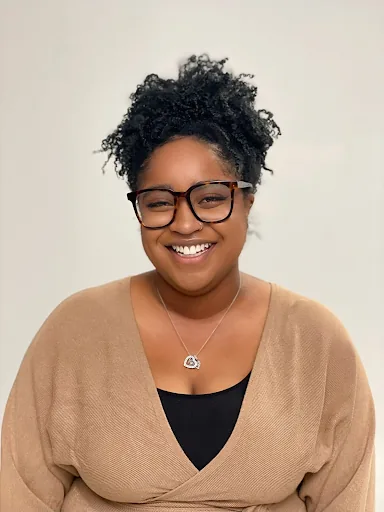
This Isn’t Just Hair. It’s My Voice
Speaking on the theme Identity at Speaker Slam® in Toronto on Jul 21, 2026, Lyrique Richards took the stage with a five minute story.
Transcript
I had. I have a confession. Until tonight, if you asked me to do that in a room full of people, I would have said "absolutely not." In fact, when I came out here tonight in my bonnet, I swear I heard all the aunties in the world gasp in unison. Because where I come from, they don't do that in public. You have to make sure your hair is in order before people see you. You have to make sure everything is neat, tidy, and presentable.
And for a long time I believed that I should be the same. Because letting people see my natural hair is like letting them see a part of me that doesn't belong in public. My very first memory is related to hair. I'm in the living room, sitting on the floor between my mom's legs. We watch The Montel Williams Show and she braids my hair. I remember walking up the stairs in elementary school. We were going out for a break, and the guy behind me said, "Your hair."
I thought I was going to get a compliment now. " Your hair looks like little snakes." My favorite hairstyle, the one I adored, the one my mom spent three hours on—was ruined. Children are curious. They don't mean to cause harm, but sometimes their questions make a young black girl doubt herself. And the questions kept pouring in. Is this your real hair? Why does it look like that? Can I touch it? As if I'm some kind of exhibition creature. And it wasn't just from the children.
Gradually, I began to realize that my hair was different. And being "different" wasn't always pleasant. But what is “good hair”? The funny thing is that no one has ever had to define it. We all knew: beautiful hair is long, straight. Beautiful hair is light curls. Beautiful hair is easy and obedient. The tighter the curl, the more judgment, the deeper the feeling of shame. I heard the words “unkempt,” “shaggy,” “dirty ”—words that stuck to hair that looked like mine. And after a while, those words stopped sounding like thoughts about hair and started sounding like thoughts about me.
And that's the thing about other people's definitions. If you wear them long enough, you stop doubting whether they are true. You just start living as if it's true. Somewhere along the way, I stopped defining myself and let others do it for me. So I spent a decade, and mind you, I'm only 27, so you can imagine how young I was when this all started. I spent decades trying to tame my hair, manage it, hide it, conceal it. Then the world went into quarantine, and I couldn't just trust my hair to someone else anymore.
Only I am left. So I signed up for what I like to call " YouTube University." I learned about porosity, twistouts, wash and go, protective hairstyles. I spent months studying. I thought I was learning how to take care of my hair, but in reality I was learning to separate my own voice from other people's voices. Voices that said my hair was " too much." Voices that said my hair wasn't professional enough, was n't acceptable enough, wasn't pretty enough. None of these votes belong to me.
I just wore them for too long. I believed they were real. For the first time in my life, I didn't try to change my hair. I was just trying to understand him. The more I learned, the more I appreciated him. The more I appreciated him, the more I cared for him. And the more I cared about him, the more I cared about myself. So, what I learned was not a hair care journey. It was a journey into myself. It's not just hair.
This is my voice. For so long I lived by other people's definitions until one day I realized something. People who judge you shouldn't live your life. It's up to you. You are so alone. Why waste time trying to be someone else? I guarantee you that there is someone in this room who would rather be you. So why take it for granted? Thank you.
Transcript generated from the recording and lightly cleaned. Some names and wording may differ from the spoken speech.