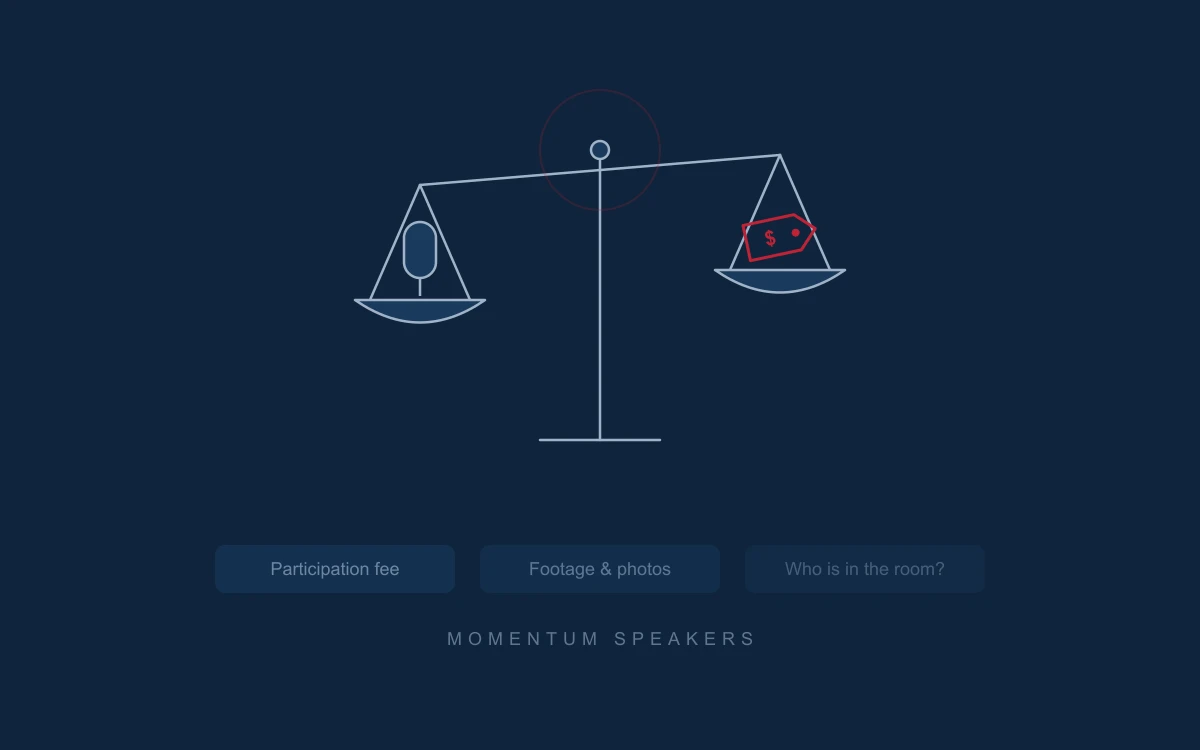
"I don't pay to speak."
That's the #1 pushback I hear about Speaker Slam®, because competing involves a participation fee.
Sometimes it comes from people who genuinely don't have the funds. But more often, it comes from people who are offended by the idea that there's a fee to participate at all. And it isn't only us. Plenty of conferences send experts an invitation to speak, and then, in the second paragraph, a "speaker participation fee."
And I get it. You have expertise. You have valuable insights. You have experience and testimonials to back that up. Why would you pay someone for the privilege of sharing it?
Some speakers delete that email on principle. Others pay without asking a single question and get nothing back. Neither reaction serves you. Pay to speak conferences are a real part of this industry. Some are worth it and some aren't, and the difference is easy to spot once you know what to look for. So I want to be transparent about how I think about it, and give you a way to judge any paid opportunity, including ours.
Understand the Model First
Before you decide, it helps to know that events run on very different business models. I've been running events for 20 years, and the money works differently in each of these:
Corporations have budgets for training, workshops and events. When they bring in a speaker, they expect to pay one.
Associations host conferences and annual meetings for their members, and many have a speaker budget built in.
Schools and nonprofits usually have much smaller budgets for speakers, and often none at all.
Independent events are a different world. An independent organizer may be paying for the venue, the production, the video team, the photographer and the marketing out of their own pocket, and hoping ticket sales cover it. Some ask speakers to share part of that cost.
So why would anyone speak there?
Some people simply want to inspire an audience. Some want to practice their material. Some need professional footage and photos for their marketing. Others want the credibility that comes with a big stage and a strong lineup.
A pay to speak request from an independent event isn't automatically a scam. A pay to speak request from an organization with a training budget deserves a lot more questions.
Think Like a Brand
If you're saying "I don't pay to speak," you're thinking like a speaker… not like a brand.
Speakers wait to get paid.
Brands invest in becoming the person people want to pay.
Every professional speaker you admire began by investing first: in visibility, credibility, coaching, brand assets, and getting in the room. The value of a good paid stage goes far beyond stage time. It's professional footage in front of a live audience. Professional photography. Speaker training. Brand positioning. Credibility. Momentum. Connection. Recognition.
So no, don't pay to speak.
Pay to build a brand that gets paid to speak.
Big difference. And that difference is also your test. If a paid opportunity builds your brand in ways you can measure and reuse, it may be a smart investment. If all it offers is a slot on an agenda, it's an expense.
A Simple Decision Framework
Before you pay for any speaking slot, answer these five questions honestly.
1
What Exactly Am I Getting?
Ask for the deliverables in writing. Professional video of your talk? Stage photos? Promotion to the organizer's audience? Coaching or feedback? If the only answer is "exposure," walk away.
2
Who Is in the Room?
The thing that determines the success of an event is who's in the room. A smaller audience of decision makers in your niche is worth more than a large room of people who will never hire you, refer you or buy your book.
3
Can I Use the Assets?
Confirm you'll receive the video and photos and can use them in your reel, on your website and on social media. Footage you can't use removes most of the value. For what to do with it once you have it, see what makes a great speaker reel.
4
Is the Stage Credible?
Is there a selection process, a professional production, respected judges or partners, a venue people recognize? A stage anyone can buy carries little weight. A stage you had to earn carries a lot. At Speaker Slam®, you aren't just given the stage. You qualify for it.
5
Where Am I on My Path?
Early in your speaking career, investing in footage, photos and social proof can accelerate everything that follows. Once you have a strong reel, testimonials and paid bookings, your marketing should be bringing you paid stages, and paying to speak rarely makes sense. I walk through that progression in how to get paid speaking gigs.
When a Paid Slot Can Make Sense
You need professional stage footage. If you have no reel yet, a well-produced event can solve your biggest marketing gap in a single night.
The audience is your buyer. The room is full of the exact people who book, hire or refer someone like you.
The credibility is transferable. You'll be able to say where you spoke, show the photos, and point to the judges, partners or venue.
There's structure and feedback. Coaching, rehearsal support or expert judging can improve your talk, and that pays off on every stage afterward.
You have a plan to leverage it. You know in advance how you'll use the footage, the photos and the connections. One stage only becomes momentum if you build on it. More on that in how speakers turn one win into momentum.
Red Flags to Watch For
Vague promises. "Massive exposure" or "guaranteed bookings" with no specifics.
No video, or video sold separately. The most valuable asset should be part of the package, and it should be yours to use.
No curation. Every speaker on the bill seems to have simply paid, with no application or selection.
No straight answers. The organizer can't tell you roughly who attends, how the event is promoted, or what the fee covers.
Pressure tactics. Countdown timers and "only one spot left" urgency with no time to ask questions.
A paying client asking you to pay. Corporations and associations typically have speaker budgets. If one of them asks for a fee to put you on their main stage, ask why.
Have you been asked to pay to speak? What did you decide?
Keep reading: What Is a Positioning Statement and Why Every Speaker Needs One · How Much Do Keynote Speakers Make in Canada? · How to Get Booked for Corporate Speaking Gigs
Your Next Step
Before you spend money on any stage, get clear on what's actually standing between you and paid bookings. Take The Paid Speaker Audit to see where your brand stands today and which investments will move you forward fastest.