I froze on Dragons' Den.
My business partner and I walked out in gowns from our own shop. I knew that business inside and out. I took a deep breath, smiled, and then I couldn't breathe. I could feel the words trapped in my throat. My body betrayed me!
After a few minutes, I realized I'd blown the pitch, so I relaxed and poured my heart out about the women we served. By the end, the Dragons said, "We don't like retail, but we do love you," and made us an offer. (We turned it down, but that's a story for another day.)
What I learned that day is that the person with the most inspirational story, rooted in their authenticity and speaking from their heart, is the most powerful person in any room. That was the catalyst for me wanting to build my speaking skills.
That moment is my signature story. Here's how to find yours.
Most People Have a Choosing Problem
You've lived through a lot. Career pivots, losses, wins, near misses. So when someone asks you to share a personal story in a speech, you start at the beginning of your life and work forward. Or you pick the most dramatic thing that ever happened to you, whether or not it connects to your work.
The audience listens politely. Then they forget it by the time they reach the parking lot.
A signature story is the one story you can tell again and again, on stages, on podcasts and in sales conversations, that instantly shows people who you are and what you stand for. It's the foundation of your personal brand and thought leadership. As Dan and I head into our 9th year of Speaker Slam®, I'm more convinced of that than ever.
Start With Your Message, Not Your Memories
This is the step almost everyone skips.
Many speakers start with a story. It's very meaningful to them. Perhaps it's an adversity they overcame, or an origin story that explains their journey. But for it to connect and mean something to the audience, the message needs to be clear and universal.
All of this starts with one thing: your message. Your personal brand is so much deeper than colors and fonts. It's your values and beliefs. It's your core message.
When you know the message first, choosing the story becomes so much easier. Instead of asking "what is my most interesting experience?" you get to ask a sharper question: "which moment from my life proves this point best?"
A few questions to find your message:
- What do you wish more people understood about your field or your community?
- What belief did you have to unlearn to get where you are now?
- If the audience remembered one sentence from you, what should it be?
Write your answer in one plain sentence. That sentence is the filter for everything that follows.
The Catalyst Story Method
We've run Speaker Slam® competitions with the theme Catalyst more than once, and it's my favorite way to think about story. Four steps.
1
Pick the Catalyst Moment
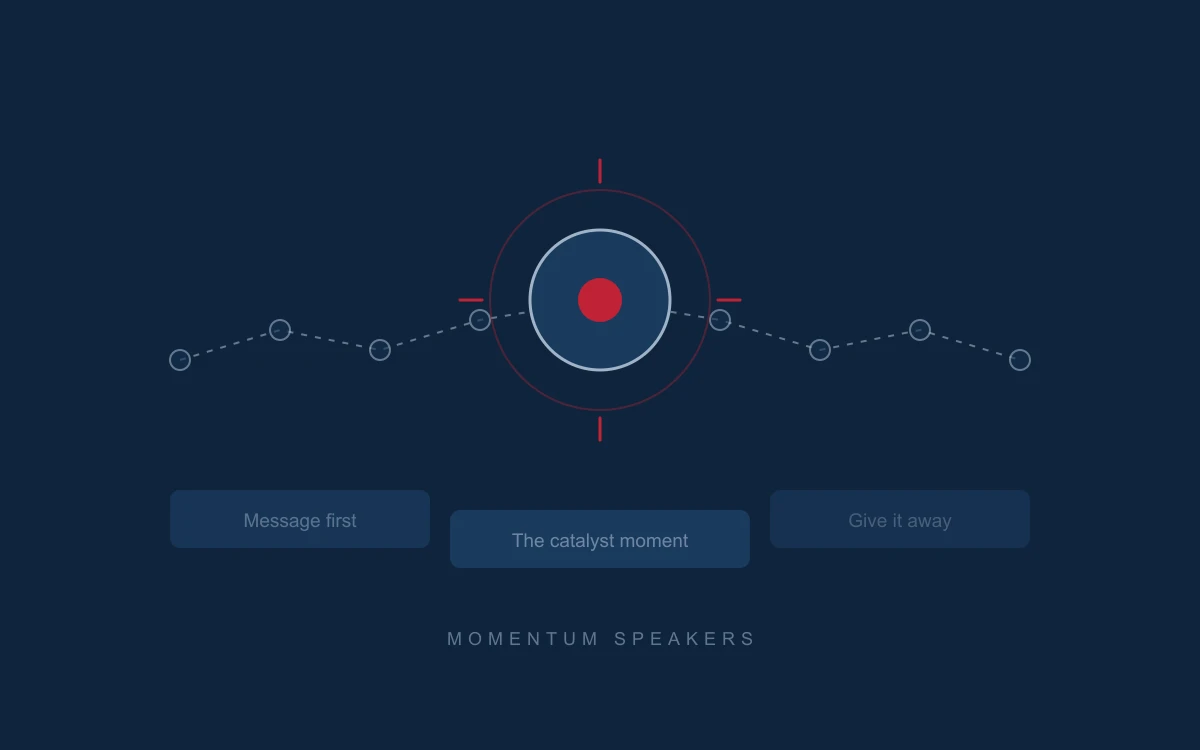
Your catalyst moment is a single point in time when something shifted. A phone call. A diagnosis. A door that closed. A pitch where you froze in front of the Dragons. It should be specific enough that you could tell me where you were standing and what you could hear.
Resist the urge to pick a whole chapter of your life. A year of struggle is a summary. The night you finally made a decision is a moment.
2
Add the Story
Now build the scene around that moment. Who was there? What did you feel in your body? What did you want, and what was in the way? Give the audience enough detail to step inside the moment with you, and no more than that.
3
Add the Message
What did that moment teach you? This is where the sentence you wrote earlier comes back. The story is the evidence. The message is the meaning you took from it.
4
Give It to the Audience
This is the step that turns a personal story into a speech. Hand the message to the people in the room so they can use it in their own lives. The best inspirational talks end on a universal truth. There is no ego, no "teaching", no "preaching", only sharing truth.
Your experience opens the door. Their takeaway is the reason you walked through it.
Five Rules That Sharpen Your Story
Once you have a draft, these are the edits I make over and over with my speakers.
No preamble. Go right into your story. Be captivating. Be entertaining. The first line of your talk should already be inside the moment.
Cut the extra details. Street names, side characters, background that doesn't move the story forward. Every detail you remove makes the moment that remains stronger. If it doesn't serve the message, it goes.
Don't clutter the ending. After your most emotional line, stop. So many speakers hit a powerful closing sentence and then keep talking, adding one more lesson or one more thank you. Find your last line, say it, and let it land.
Make the turn from "I" to "you." The best signature stories begin with your experience and end with the audience's. That turn is what makes a story feel generous instead of self-focused.
Heal before you tell. Some of the most meaningful stories are painful ones. If your story is painful, do the work of moving through it first, before you bring it on stage. A story you're still in the middle of can take over the room, or take you over at the microphone. A story you've worked through can be told with clarity, and the audience feels safe going there with you.
Choose the moment that proves your message. Then give the message away.
How to Know You've Found It
Test your draft with these questions:
- Can you tell it in under three minutes without rushing?
- Does it start inside a specific moment?
- Could you state the message in one sentence after telling it?
- Does the ending hand something to the audience?
- Can you tell it without falling apart, while still feeling it?
If the answer to all five is yes, you likely have your signature story. Expect to refine it every time you tell it. The core moment stays. The edges get sharper.
Your signature story then becomes the backbone of your brand. It goes into your keynote opening, your bio, your podcast interviews and your speaker reel. The ideal speaker combines a strong expertise with an inspiring and unique lived experience. Your story is how people feel the second part.
Once you have it, learn to deliver it well. Start with how to memorize a speech without sounding robotic, and stay clear of the speaker mistakes that stop you getting rebooked.
Twice a year, Dan and I host a free Launch Your Speaking Journey session, and I always guide people through this exact exercise. One speech can change your life.
So what's your catalyst moment? I'd love to know.
Keep reading: The Difference Between a Story and a Timeline · How to Write an Inspirational Speech That Actually Moves People · How to Get Over Stage Fright: What Experienced Speakers Do Differently
Your Next Step
Finding your signature story is easier with a coach and a room of people giving honest feedback. That's exactly what we do inside our speaker training: message first, catalyst moment second, and a story that gets you booked.